

ICC T20 World Cup 2026 | March 2026
A National Conversation on Sport, Religion & Identity
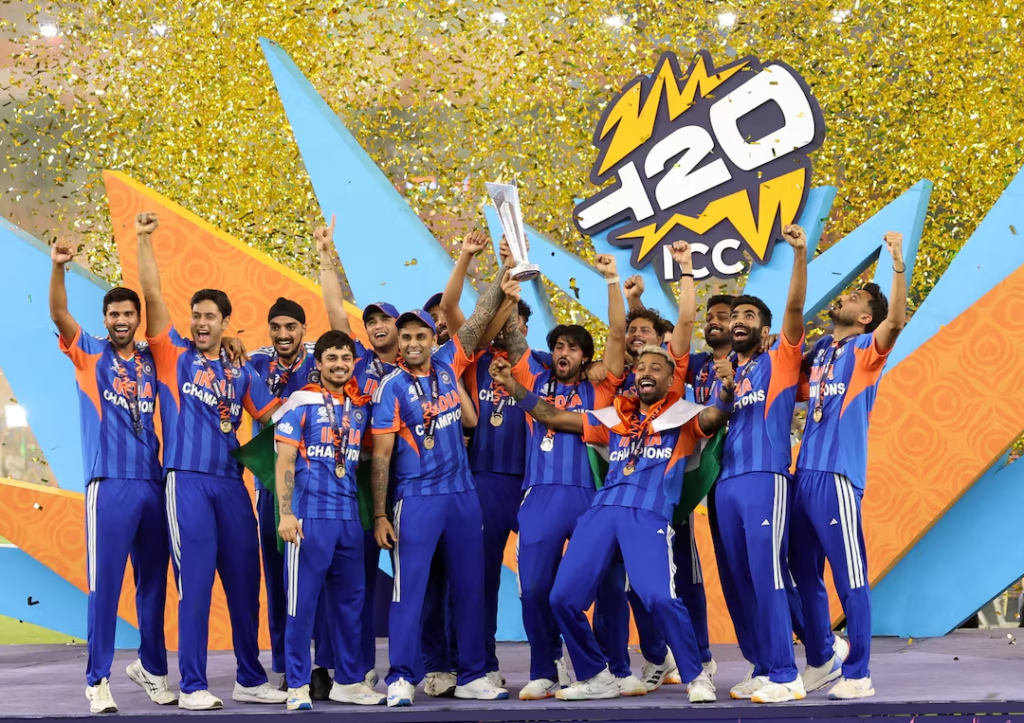
When India lifted the ICC Men’s T20 World Cup trophy on March 8, 2026, defeating New
Zealand by a commanding 96 runs at the Narendra Modi Stadium in Ahmedabad, the nation
erupted in joy. But within hours, a post-match ritual ignited a fierce national debate — one that
touched the raw nerves of religion, secularism, and what it means to represent a billion-plus
diverse people – Kirti Azad’s Statement on Ishan Kishan Sparks Major Cricket Controversy.
THE HISTORIC WIN : A World Cup Final Record

India’s triumph in the ICC Men’s T20 World Cup 2026 was nothing short of historic. The Men in Blue,
captained by Suryakumar Yadav, made cricketing history by becoming the first team ever to
successfully defend the T20 World Cup title, win the tournament on home soil, and clinch the coveted
trophy for a third time overall (2007, 2024, and 2026). The final at the Narendra Modi Stadium in
Ahmedabad — the world’s largest cricket ground — was an emphatic display of India’s batting
dominance and bowling precision.
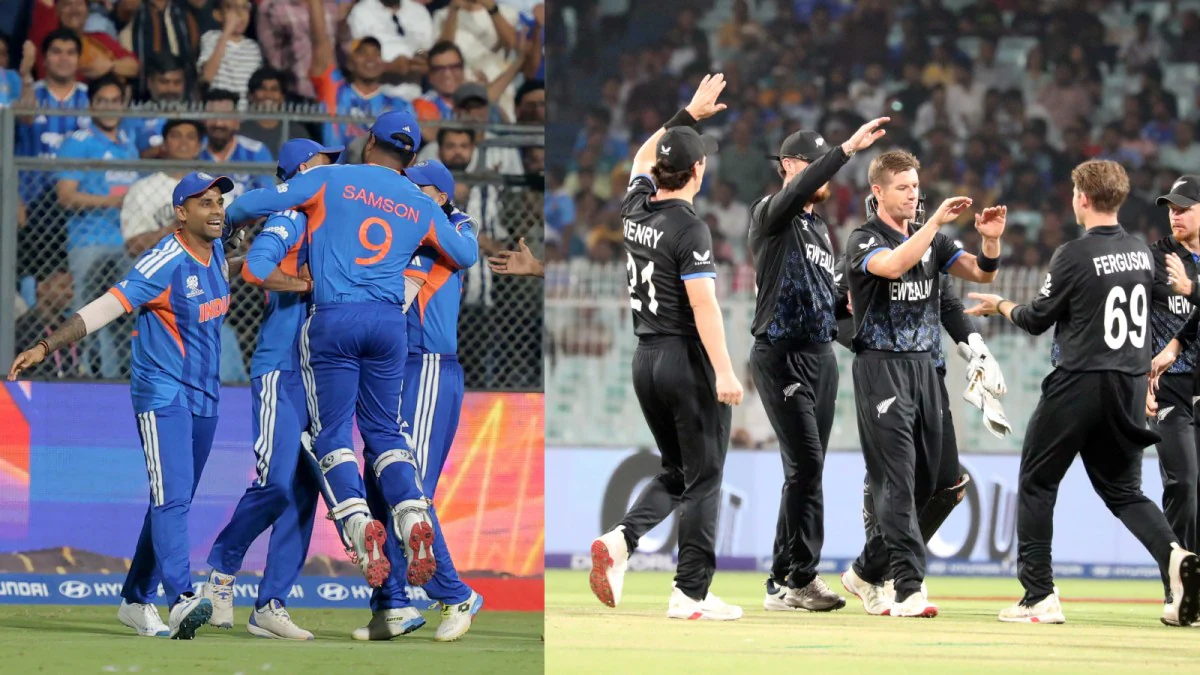
The match itself was a one-sided affair. India posted a record-breaking total of 255/5 in their 20 overs,
powered by explosive knocks from Abhishek Sharma (52 off 21 balls), Sanju Samson, and
wicketkeeper-batter Ishan Kishan, who smashed 54 off just 25 balls in the final — the highest individual
score of the match. New Zealand, chasing an enormous target, could only manage 159 all out, handing
India a 96-run victory. The BCCI announced a prize purse of 131 crore for the winning squad, sparking
further debate about whether the reward matched the scale of the achievement.
THE TEMPLE VISIT THAT SPARKED A STORM

In the euphoric aftermath of the final, Team India’s captain Suryakumar Yadav, head coach Gautam
Gambhir, and ICC Chairman Jay Shah visited the Hanuman Tekri temple in Ahmedabad — located
near the Narendra Modi Stadium — to offer prayers of thanksgiving. They carried the gleaming T20
World Cup trophy with them during this religious visit, offering it before the deity as a gesture of
gratitude.
For many Indians, such acts of faith after a significant victory are entirely natural and deeply personal.
Players visiting temples, mosques, churches, and gurudwaras before and after important matches has
been a long-standing tradition in Indian cricket. However, in this instance, the official involvement of the
World Cup trophy — a national symbol won collectively by a diverse squad — at a specific religious site
raised questions about the appropriateness of such a gesture, coming from the team’s leadership and
the chairman of the global governing body for cricket.
KIRTI AZAD’S CRITICISM

The controversy was ignited on March 9, 2026 — just one day after India’s victory — when Kirti Azad
took to social media platform X (formerly Twitter) with a strongly-worded post that sent shockwaves
through Indian cricket circles. Kirti Azad, a member of the 1983 World Cup-winning team under Kapil Dev
and a sitting Trinamool Congress (TMC) Member of Parliament, questioned the wisdom and inclusivity
of carrying the national trophy to a Hindu temple.
Kirti Azad drew a sharp contrast with the 1983 World Cup victory, reminiscing that Kapil Dev’s legendary
squad was a mosaic of India’s diverse faiths — Hindus, Muslims, Sikhs, and Christians — yet the trophy
was simply brought back to the motherland without being associated with any single religion. He
pointedly asked why the trophy was not also taken to a mosque, a church, or a gurudwara — noting that
Muslim players like Mohammed Siraj and Christian players like Sanju Samson — the latter being
named the Player of the Tournament — had not taken the trophy to their own respective places of
worship.
Kirti Azad’s central argument was rooted in the concept of secular national identity: a sportsperson, he
argued, does not belong to any religion or caste — they belong only to their sport. The 2026 Indian
team, like every Indian national team, represents all 140 crore citizens of the country, regardless of their
faith. Making the trophy part of a religious ceremony at a single place of worship, he contended,
undermines this inclusive ideal.
GAMBHIR HITS BACK

India’s head coach Gautam Gambhir was swift and emphatic in his response. In a post-tournament
media interaction, Gambhir dismissed Kirti Azad’s criticism as unworthy of a serious response, calling it
deeply unfair to the players who had worked tirelessly to bring the trophy home. “I think it’s not even
worth answering that question,” he said. “It’s a big moment for the entire country. We should celebrate a
World Cup win. Statements like these only dilute the achievement of the players.”
Gambhir further highlighted the emotional and physical toll the tournament had taken on the squad. He
noted that after India’s one defeat in the group stage (against South Africa), the team had faced intense
scrutiny and pressure. The boys had pushed through all of that, he argued, and deserved to celebrate
without having their personal moments of gratitude politicised. “Imagine that the boys have gone
through so much — the amount of pressure they’ve been under… Today, if you are giving such a
statement, you’re literally degrading your own players and degrading your own team, which should not
be done,” Gambhir added.

HARBHAJAN & OTHERS WEIGH IN
The debate quickly spilled over into broader cricketing circles. Former India spinner Harbhajan Singh
came out firmly in support of the team’s management, rebuking Kirti Azad for what he termed the
politicisation of a purely sporting achievement. Harbhajan argued that individual players have always
been free to express their faith in their own ways, and that reading political or sectarian motives into a
genuine act of personal gratitude was misplaced.
Harbhajan also touched on the 131 crore prize money announced by the BCCI, stating he had
expected a higher reward given the magnitude of the historic achievement: “I was expecting more,
because when such a big task is undertaken, the reward should be even greater.” He nonetheless
congratulated the team warmly, praising their dominance throughout the tournament.
Wicketkeeper-batter Ishan Kishan, who had just returned to a hero’s welcome in his hometown of
Patna, was asked by reporters to comment on Kirti Azad’s remarks. Kishan — who had scored a vital 54 off
25 balls in the final — appeared visibly frustrated by the question and firmly redirected the conversation.
He urged journalists to focus on the extraordinary achievement of winning the World Cup rather than
engage with political controversy with Kirti Azad.

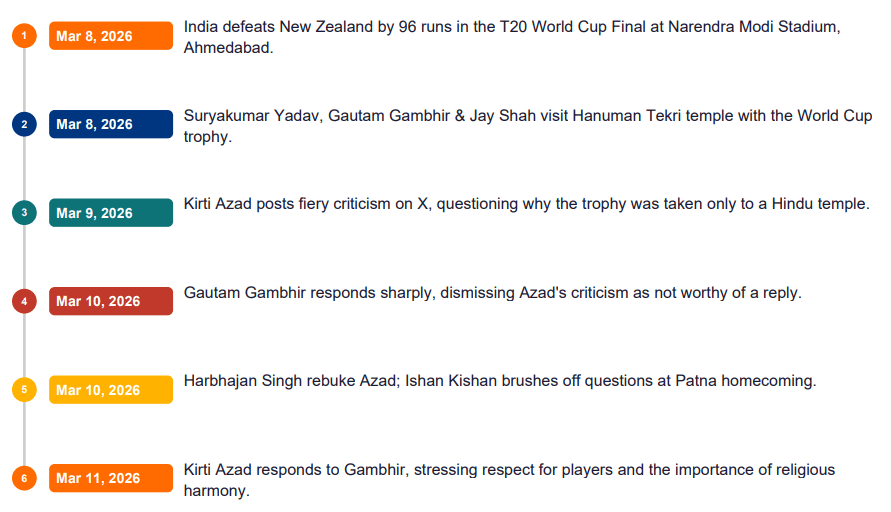
TIMELINE OF EVENTS
AZAD RESPONDS TO GAMBHIR
Rather than backing down, Kirti Azad issued a measured rebuttal to Gambhir’s sharp words. Speaking
to reporters on March 11, 2026, Kirti Azad acknowledged that players should never be degraded or
disrespected — even in the heat of debate — while simultaneously reiterating the core of his original
argument. He stressed that in a democratic and diverse country like India, it is essential that all religions
be treated with equal respect, particularly in the context of national sporting celebrations that are meant
to unite, not divide.
Kirti Azad’s position was nuanced: he was not attacking the personal faith of Suryakumar Yadav, Gambhir,
or Jay Shah. Rather, he was raising a broader institutional question about the symbolic use of a national
trophy — which belongs to the entire country — in an exclusively religious setting. It is worth noting that
the BCCI had not issued any formal statement on the temple visit by the time this article was compiled,
leaving the controversy to simmer in the public domain.
THE BIGGER PICTURE: SPORTS, FAITH & SECULARISM
The temple controversy is not an isolated incident in Indian sport. It reflects a recurring tension in one of
the world’s most religiously diverse nations: the balance between individual freedom of religious
expression and the secular, pluralistic identity of national institutions. Indian cricket, in particular,
occupies a quasi-religious status in the country’s cultural life — it is one of the few arenas where the full
tapestry of Indian society comes together under a single banner.
Individual players visiting temples, dargahs, churches, and gurudwaras for personal blessings is widely
accepted and celebrated across India. What made this episode different was the involvement of the
trophy itself — an ICC property and a symbol of collective national achievement — alongside the
team’s head coach and the chairman of global cricket’s governing body. Critics like Kirti Azad argue that this crossed an invisible but important line, transforming a personal act of faith into an institutional
endorsement.
Supporters of the visit, on the other hand, argue that reading such intent into a spontaneous act of
gratitude is an over-politicisation of what was a deeply human moment. They point out that faith has
always been intertwined with Indian public life, and that imposing a rigid secular standard on a private
emotional expression is itself a kind of intolerance. The debate ultimately reflects the ongoing
negotiation in Indian public life between majority cultural expression and the constitutional guarantee of
equal respect for all faiths.
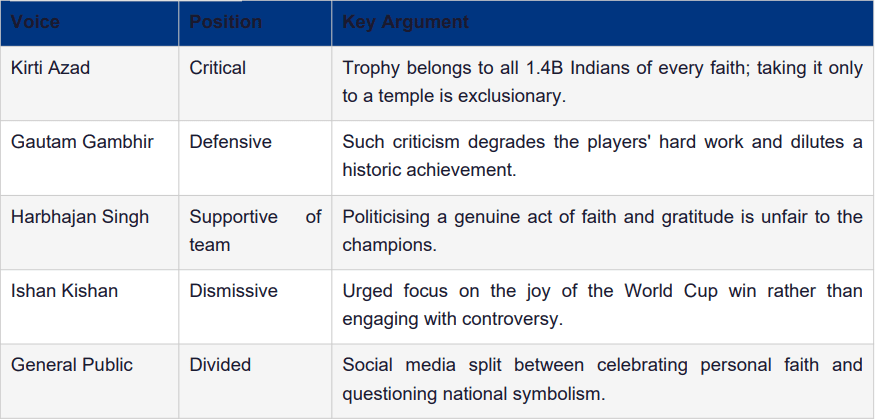
Perspectives at a Glance
CONCLUSION
India’s T20 World Cup 2026 triumph will go down as one of the most celebrated chapters in the nation’s
cricketing history — a hat-trick of titles, a successful defence, and a victory on home soil. The players
and the entire support staff deserve enormous credit for delivering under immense pressure and
expectation.
Yet the temple visit controversy is a reminder that sport, at its highest levels, is never just about sport. It
is a mirror held up to society, reflecting its hopes, its anxieties, and its deepest convictions. The debate
sparked by Kirti Azad — however uncomfortable it may have been for players in the midst of their
celebrations — is a legitimate and important conversation for a pluralistic democracy to have.
Whether one agrees with Kirti Azad’s critique or Gambhir’s spirited defence, the episode underscores the
responsibility that comes with representing a nation as vast and diverse as India. The trophy, as Kirti Azad
rightly noted, belongs to every Indian — and the manner in which national symbols are deployed will
always carry meaning beyond the intentions of any individual.
Compiled March 2026 | Sources: ANI, Cricket Times, The Statesman, India TV News, The News Mill